
Categories
North Texas Real EstatePublished November 7, 2026
Texas Population: 31.7 Million & counting


It's no secret that Texas is growing, and residents are feeling the effects of that growth every day. From ongoing road construction and expanding neighborhoods to increasingly busy roads and longer commutes, the changes are becoming hard to miss. Texas is growing quickly, and while that growth brings new opportunities, it also comes with a few growing pains.
The Texas Real Estate Research Center expects Texas' growth to slow due to eroded housing affordability and the end of the pandemic-era migration spike. Based on the most recent data, the state is not losing population; in fact, it has more births than deaths. However, it's adding people at a slower rate. Though more expensive than five years ago, housing in the Lone Star State is still substantially more affordable than on the east coast. These advantages will keep the state growing, but at a lower rate than seen in recent years.
What drove this growth?
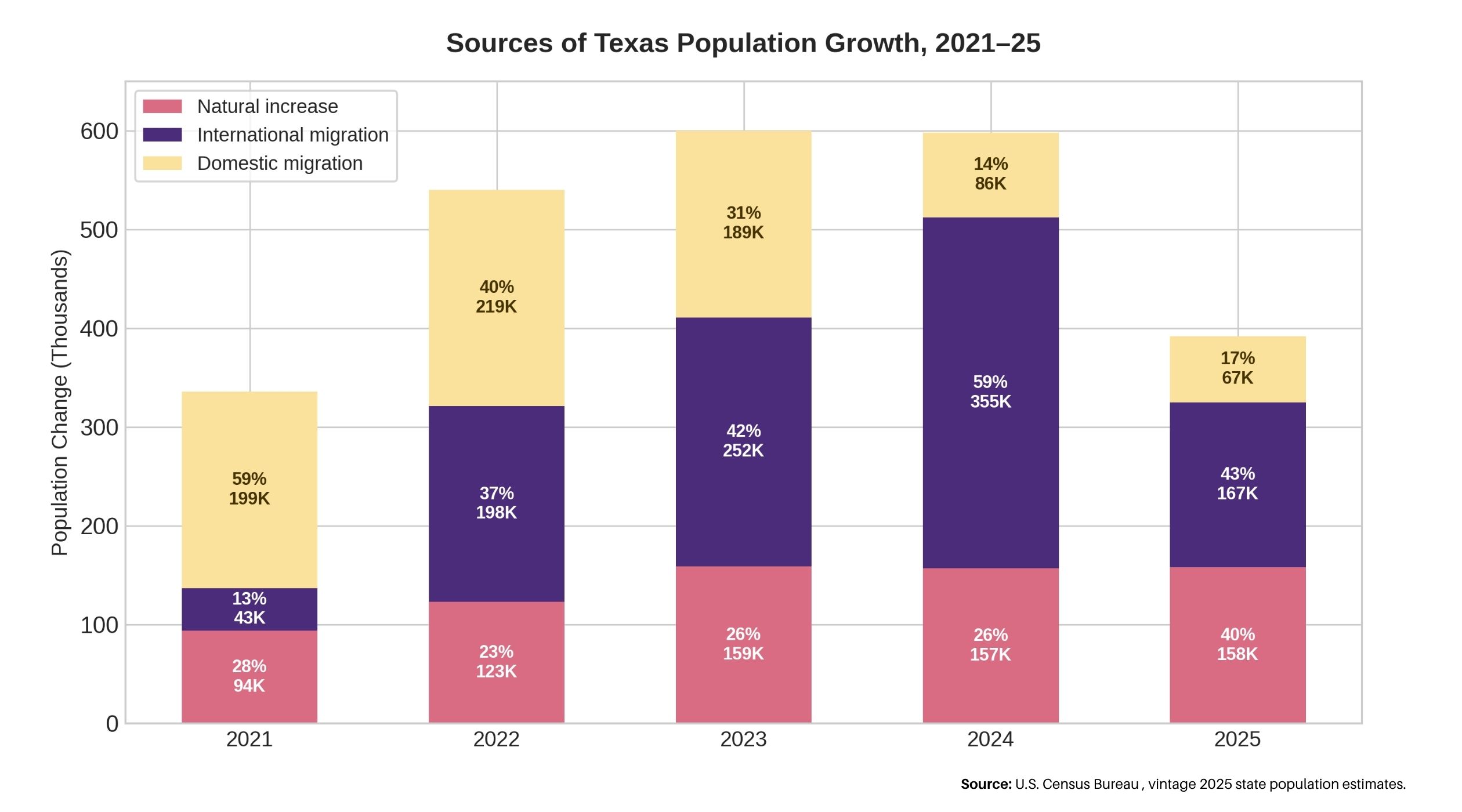
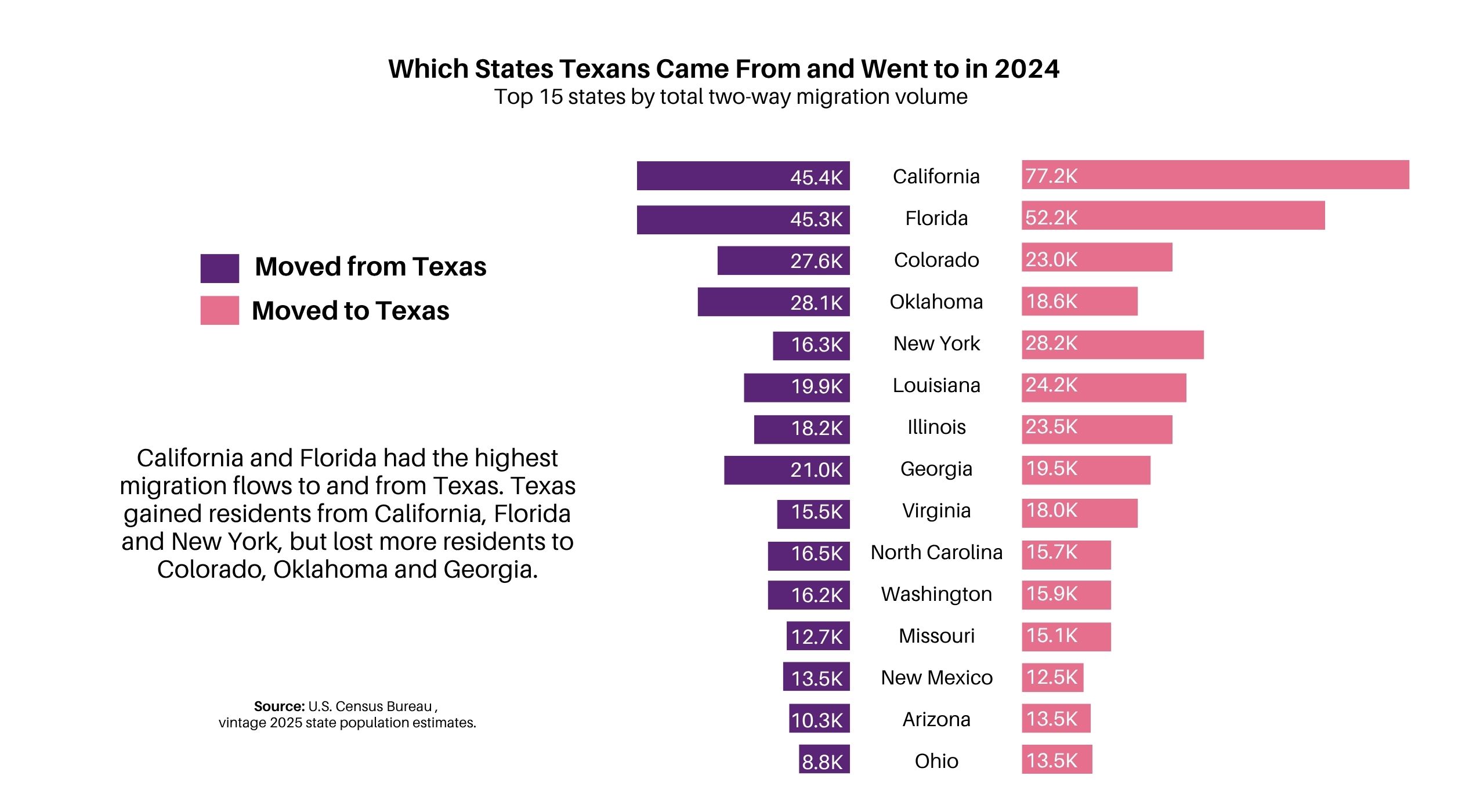
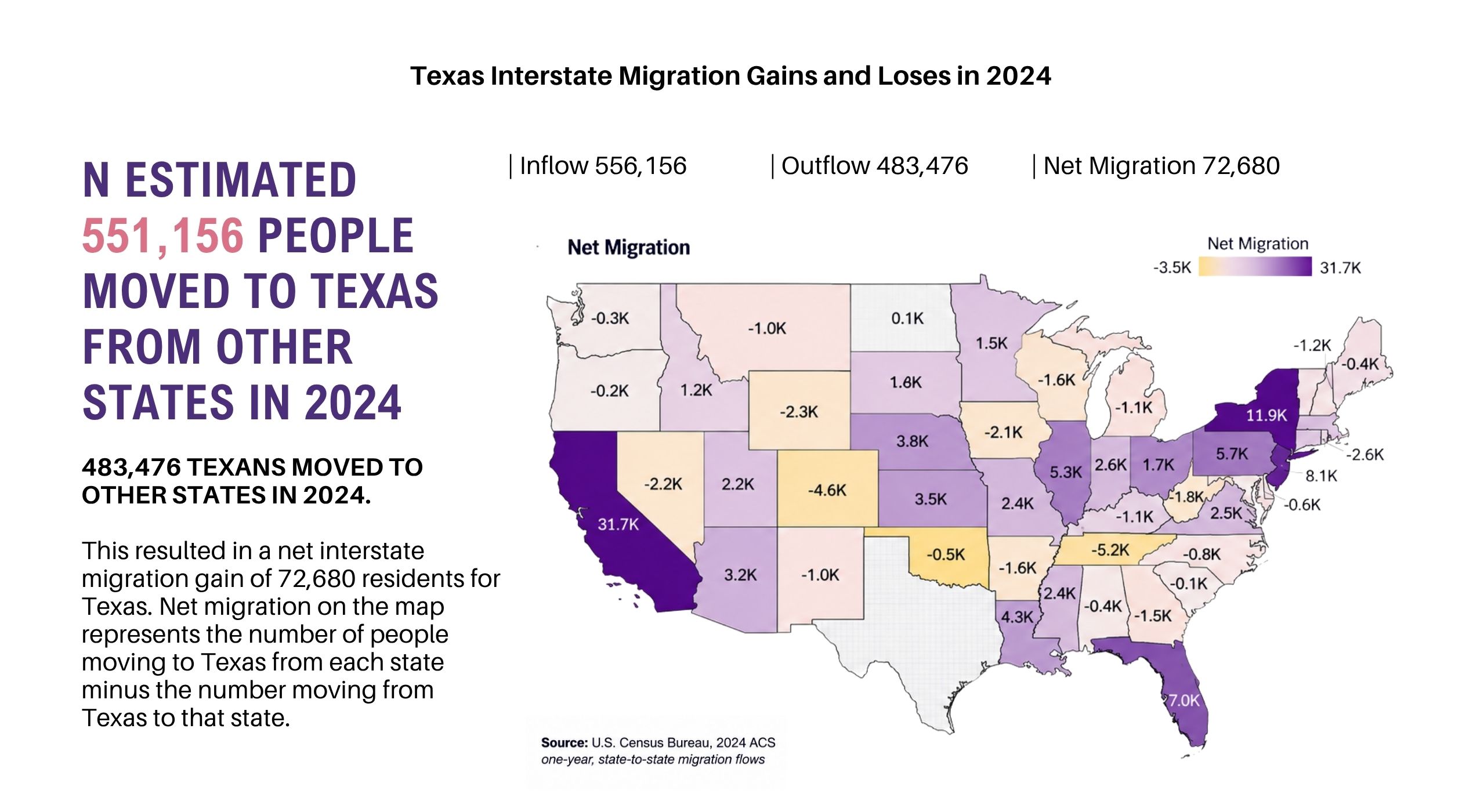
Total state population is the sum of three sources: natural increase (births minus deaths), net domestic migration (moves from and to other states), and net international (moves from and to other countries). As is typical for Texas, it was one of 19 states to grow from all three sources in 2025. Texas' post-pandemic population rebound was powered by migration, especially international migration, in 2023 and 2024. In 2025, total growth slowed as migration gains fell, while natural increase accounted for a larger share of growth.
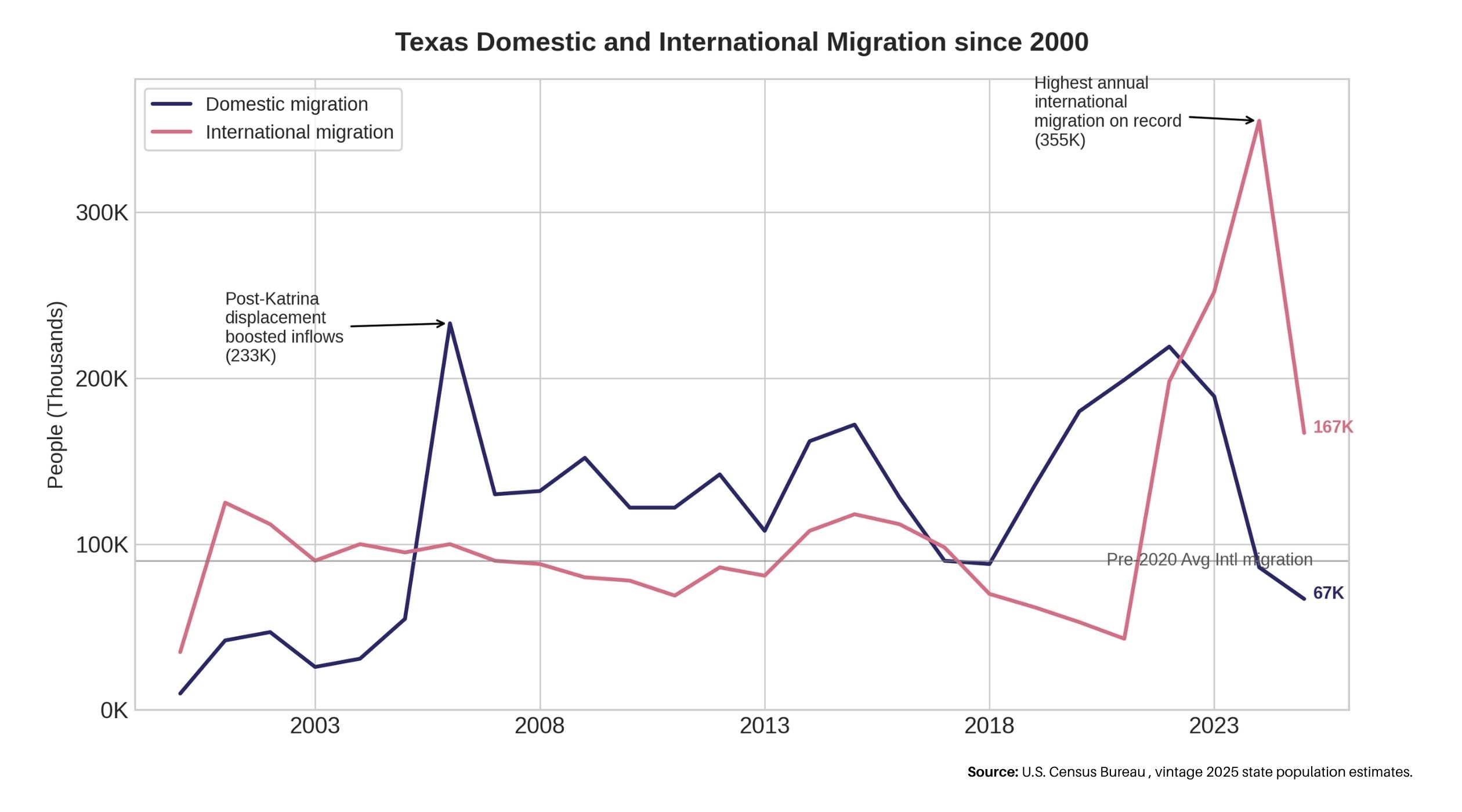
Net migration into Texas has tended to be fairly constant, influenced by its favorable economic conditions. Sometimes, major events cause sudden changes. Domestic migration received boosts from Hurricane Katrina migration and shutdown policies during the pandemic. International migration grew substantially from lenient immigration policy after 2020, reaching a record in 2024, before declining again in 2025.
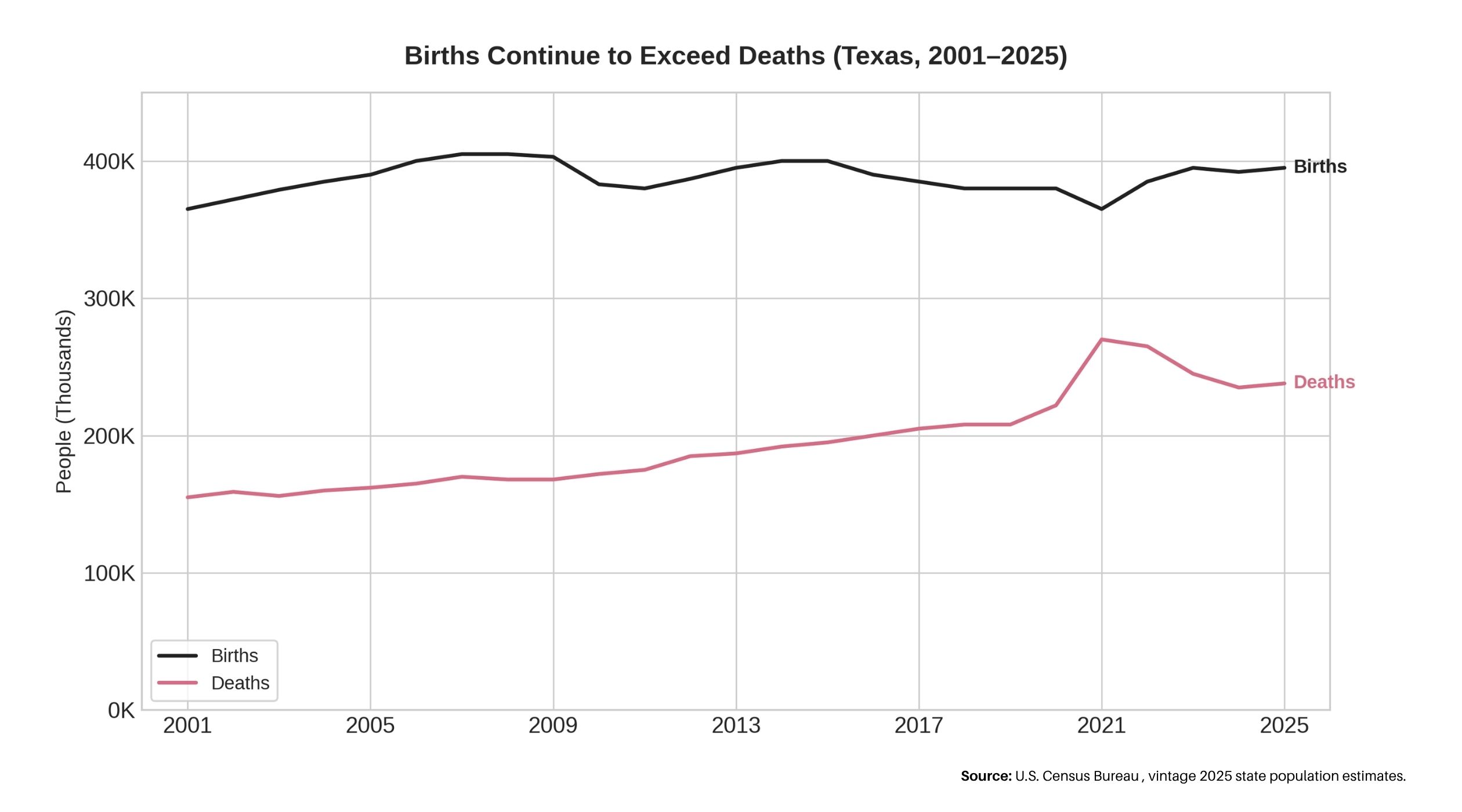
Births continue to exceed deaths in Texas, but rising deaths, especially during the pandemic, have narrowed the state's natural increase compared with the mid-2000s and mid-2010s. Relatively level numbers of births coinciding with a growing population indicates declining birth rates (fewer births per 1,000 people).
WHY ARE DEMOGRAPHIC STATISTICS SO OLD
The U.S. Constitution calls for an enumeration of population every 10 years to apportion seats in the House of Representatives. To have more timely numbers than every decade, the U.S. Census Bureau and preceding agencies have been producing annual population estimates for about a century.
Those annual numbers are not enumerations or actual counts as in a census. They're created by combining many sources, such as state birth and death certificates, and data from agencies like the IRS, Social Security Administration, and Department of Homeland Security. Once this administrative data is available, the Census Bureau fills in the gaps based on assumptions and models.
This system is considered the most sophisticated, detailed, and transparent population estimation method in the world. Still, even with automation, it takes time. The first estimates are typically released mid-winter, and more detailed numbers roll out through mid-year. These estimates are not for a calendar year, but reflect the situation on July 1 of the prior year. That means the data included in this report was released in the first half of 2026 and represents the situation on July 1, 2025.
LOOKING AHEAD: THE FUTURE OF NORTH TEXAS
Texas's population story is far from over.
With almost 32 million residents and hundreds of thousands of additional people being added each year, the state continues to evolve.
For North Texas, this means the communities we know today may look very different over the next five, ten and twenty years.
Because Texas isn't just growing in population. It's growing in opportunity, development and the communities people are choosing to call home.

Wayne Myers
Realtor & Team Lead | Wayne Myers | Keller Williams North Country
or another way